Fostering innovation in water cycle monitoring is a key part of FDRI, which includes creating cheaper, more scalable ways of understanding floods and droughts.
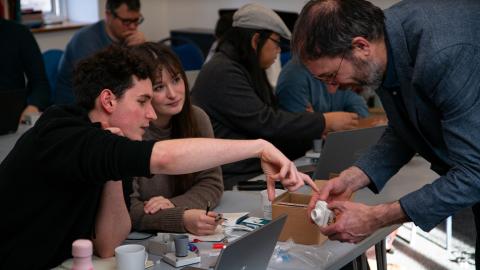
In February, FDRI’s innovation team, a collaboration between UKCEH and Imperial College London, bought together 20 innovators from diverse backgrounds to do exactly that in our first Open Hardware Workshop in the Chess catchment, one of FDRI’s three focus catchments.
We caught up with the innovation team, Alejandro Dussaillant, Luke Tumelty and Wouter Buytaert, to hear more about this exciting concept, why it’s important and what learnings the workshop uncovered.
What is open hardware?
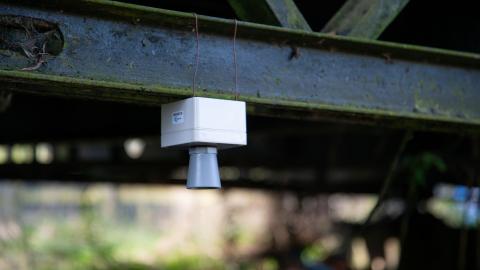
Open hardware (OH) refers to hardware whose specifications, blueprint and software code is freely available to all. Their physical components also tend to be low-cost. OH can be used to gather data that helps us understand floods and droughts, including: precipitation, soil moisture, water level, flow velocity, temperature and humidity.
Getting this data means we can create more accurate models to predict floods and droughts, as well as measure the effectiveness of interventions such as natural flood management.
How can OH improve river monitoring?
- Volume of data: Results from OH may have lower individual measurement precision, but they can be deployed in high volumes at significantly lower cost than traditional monitoring equipment. When combined with appropriate calibration, validation against reference instruments and statistical aggregation across many sensors, this uncertainty can be effectively managed. This enables much wider geographic coverage of data collection and supports experimentation and rapid iteration, providing a valuable complement to high-precision monitoring.
- Enabling inclusive research: OH lowers barriers to participation for researchers, hardware developers (start-ups) and community-based groups such as citizen science volunteers, creating space for innovation that might otherwise not be realised and, vitally, bringing those who understand local catchment processes into the research process.
What was the focus of the workshop?
- Learning: Participants, including PhD students, NGO staff and flood managers, had the chance to learn how to assemble, code and use OH.
- Networking: The workshop provided an opportunity to share ideas and make connections, kick starting the innovation community we’re building as part of FDRI.
- Iterating: Importantly, we also got the chance to learn how we can support novel approaches to monitoring in FDRI’s three target catchments.
How did it go? Hear about participants’ experience in this YouTube short.
What were the key learnings?
- There is a real need for open hardware in real-world contexts: We heard compelling pitches from participants in various UK settings, primarily in natural flood management, where the cost of hardware has limited the duration or scope of monitoring campaigns.
- We need regular, long-term engagement to nurture expertise on OH: Participants were vocal about the support they need, including regular, facilitated peer exchange meetings, how-to guides and repositories of recommended hardware. As a team, we’ll be taking these suggestions forward as we develop an FDRI innovation community.
We’re looking to run more workshops and provide incubation opportunities: sign up to the FDRI newsletter to hear about these.
Do you have an idea for how to innovate in this space? Are you interested in collaborating or promoting our work? We want to hear from you! Reach out to FDRI@ceh.ac.uk and we’ll be in touch.